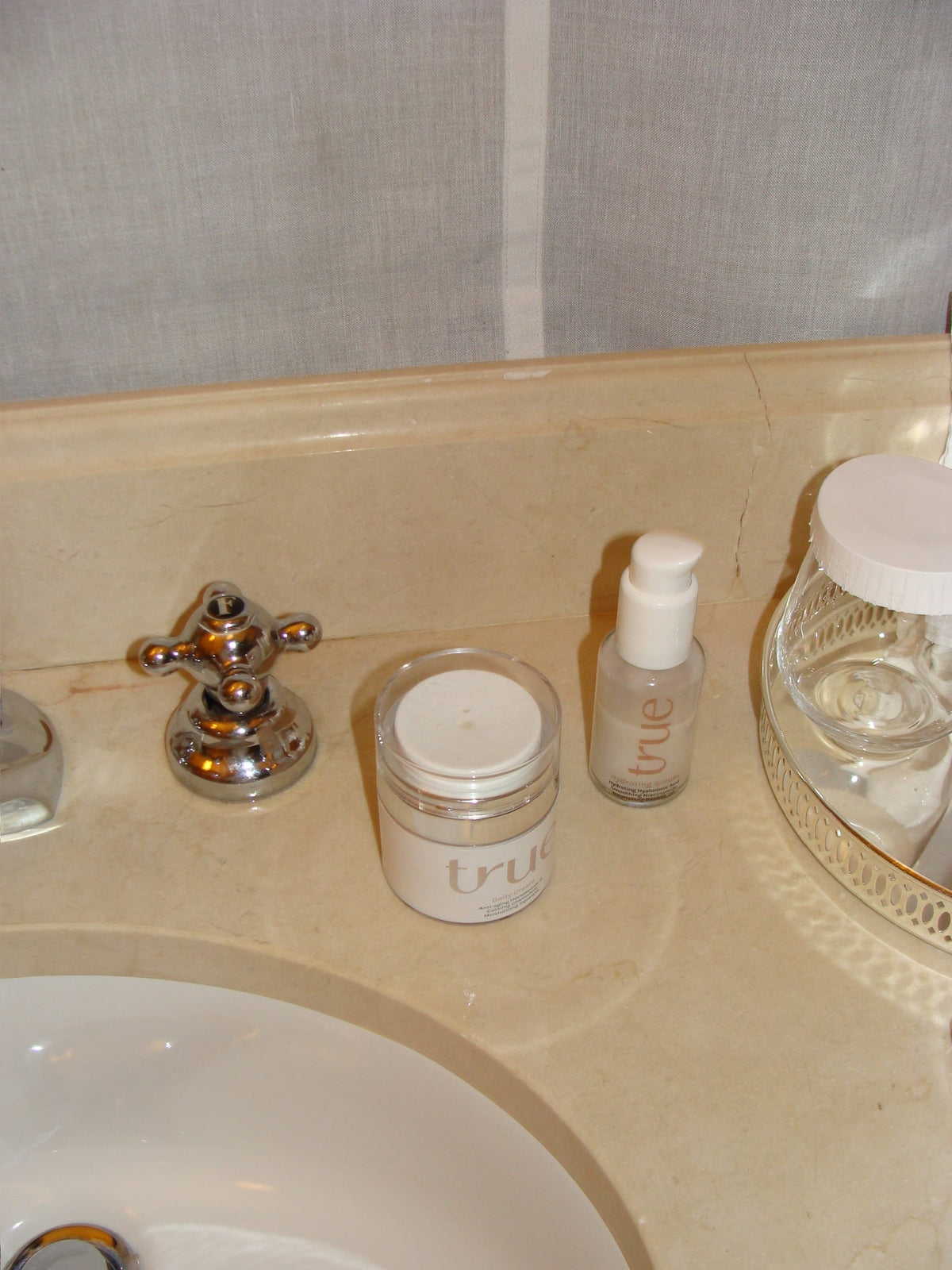
Why use both serum and cream
In short
A serum binds water inside the skin. A cream keeps it from leaving. Each does one job well and the other's badly, which is why the skin needs both.
Binds water
Hyaluronic acid, glycerin, niacinamide
Keeps water in
Squalane, peptides
What the serum does
A serum is a light, water-based carrier for humectants and small actives. In a 60-day study of 76 women, hyaluronic acid improved hydration and elasticity at every molecular weight tested, and reduced wrinkle depth with the two smallest. Glycerin restores a damaged barrier faster. Niacinamide raises the skin's own ceramide production within four weeks. Because the serum is thin, these sit close to the skin without a heavy film.
What the cream does
The water a serum binds still has to be kept. A cream supplies the lipid side: squalane, the stable form of a lipid that makes up about 13% of human sebum, slows water loss without a greasy finish. A cream is also where heavier actives belong. A peptide emulsion applied twice daily for 30 days reduced wrinkle depth by up to 30%, and the cream keeps it in contact with the skin for hours.
One without the other
Serum alone leaves the humectants with nothing over them. In dry indoor air the bound water leaves almost as fast as it arrived: the skin feels good for twenty minutes, then tight. Cream alone seals in whatever water is present, which after cleansing is not much, and it cannot carry water-soluble actives in useful amounts.
The routine
- 1 Serum on slightly damp skin, so the humectants have water to bind.
- 2One minute to absorb.
- 3 A pea of cream, warmed between the fingertips, over face and neck.
- 4 Morning and evening. Sunscreen on top in daylight.
Figures are study averages; individual skin varies.
Sources (6)
- Rawlings AV, Harding CR. Moisturization and skin barrier function. Dermatologic Therapy, 2004. Review.
- Pavicic T et al. Efficacy of cream-based novel formulations of hyaluronic acid of different molecular weights in anti-wrinkle treatment. Journal of Drugs in Dermatology, 2011. Controlled study, n = 76, 60 days.
- Fluhr JW et al. Glycerol accelerates recovery of barrier function in vivo. Acta Dermato-Venereologica, 1999. Experimental study in healthy volunteers.
- Tanno O et al. Nicotinamide increases biosynthesis of ceramides as well as other stratum corneum lipids to improve the epidermal permeability barrier. British Journal of Dermatology, 2000. Four-week clinical study.
- Huang ZR, Lin YK, Fang JY. Biological and pharmacological activities of squalene and related compounds: potential uses in cosmetic dermatology. Molecules, 2009. Review.
- Blanes-Mira C et al. A synthetic hexapeptide (Argireline) with antiwrinkle activity. International Journal of Cosmetic Science, 2002. Clinical study, n = 10, 30 days.