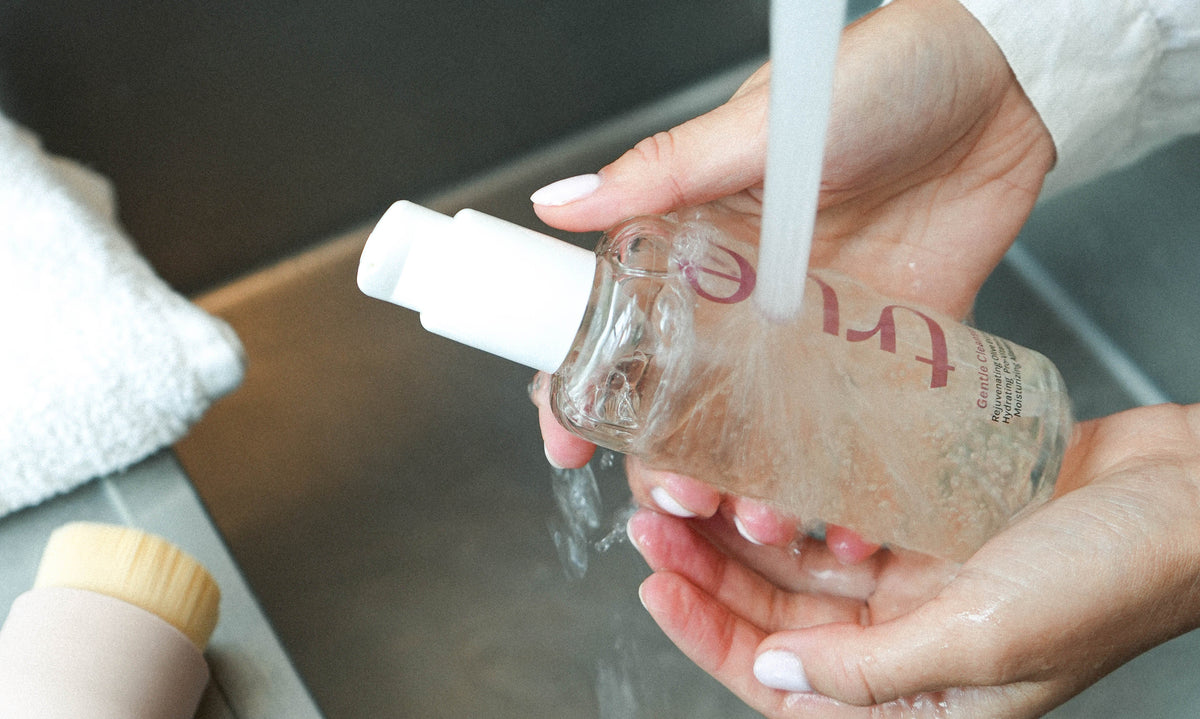
The 30-second cleanse
In short
Thirty seconds of gentle massage in lukewarm water, a cool rinse, pat dry. Long enough to lift the day off, short enough to leave the skin's own lipids in place.
- 0 s Lukewarm water 32 to 34 °C. Two pumps into clean hands.
- 30 s Massage Light circles over face and neck. No scrubbing.
- 45 s Cool rinse Until the skin feels clean rather than slippery.
- 60 s Pat dry Leave the skin slightly damp for the serum.
What a cleanser is doing
Surfactants have a water-loving end and an oil-loving end. They surround oil, sunscreen and grime so water can carry them away. They do not distinguish between the oil you want removed and the lipids that hold the outer skin together, and the longer the contact, the more they take. Cleansing is a trade between removal and damage, and time is one of the levers.
Water is part of the exposure
Ten minutes in water at 11 °C raised water loss through the skin by 36%. At 41 °C it rose by 128% and redness by 15%. Water loss climbs steeply with skin temperature, so keep the water lukewarm and the contact short. Rinsing matters as much: surfactant left on the skin keeps working, and alkaline soap residue raises surface pH and lowers hydration.
Once a day is usually enough
Every wash repeats the trade. Evening is the one that matters, because the day's sunscreen, sebum and airborne particles need to come off. Morning skin has little on it that water alone will not handle. Twice-daily cleansing suits oily skin; for most people it doubles the surfactant contact and nothing else.
The routine
- 1Evening, every day. Morning only if your skin is oily.
- 2Lukewarm water, two pumps, 30 seconds, no scrubbing.
- 3Cool rinse until the skin feels clean, not slippery.
- 4Pat dry. Serum within a minute.
Figures are study averages; individual skin varies.
Sources (5)
- Ananthapadmanabhan KP et al. Cleansing without compromise: the impact of cleansers on the skin barrier and the technology of mild cleansing. Dermatologic Therapy, 2004. Review.
- Draelos ZD. The science behind skin care: cleansers. Journal of Cosmetic Dermatology, 2018. Review.
- Herrero-Fernández M et al. Impact of water exposure and temperature changes on skin barrier function. Journal of Clinical Medicine, 2022. Observational study, n = 50.
- Mathias CG, Wilson DM, Maibach HI. Transepidermal water loss as a function of skin surface temperature. Journal of Investigative Dermatology, 1981. Measurement study.
- Gfatter R, Hackl P, Braun F. Effects of soap and detergents on skin surface pH, stratum corneum hydration and fat content in infants. Dermatology, 1997. Controlled measurement study.