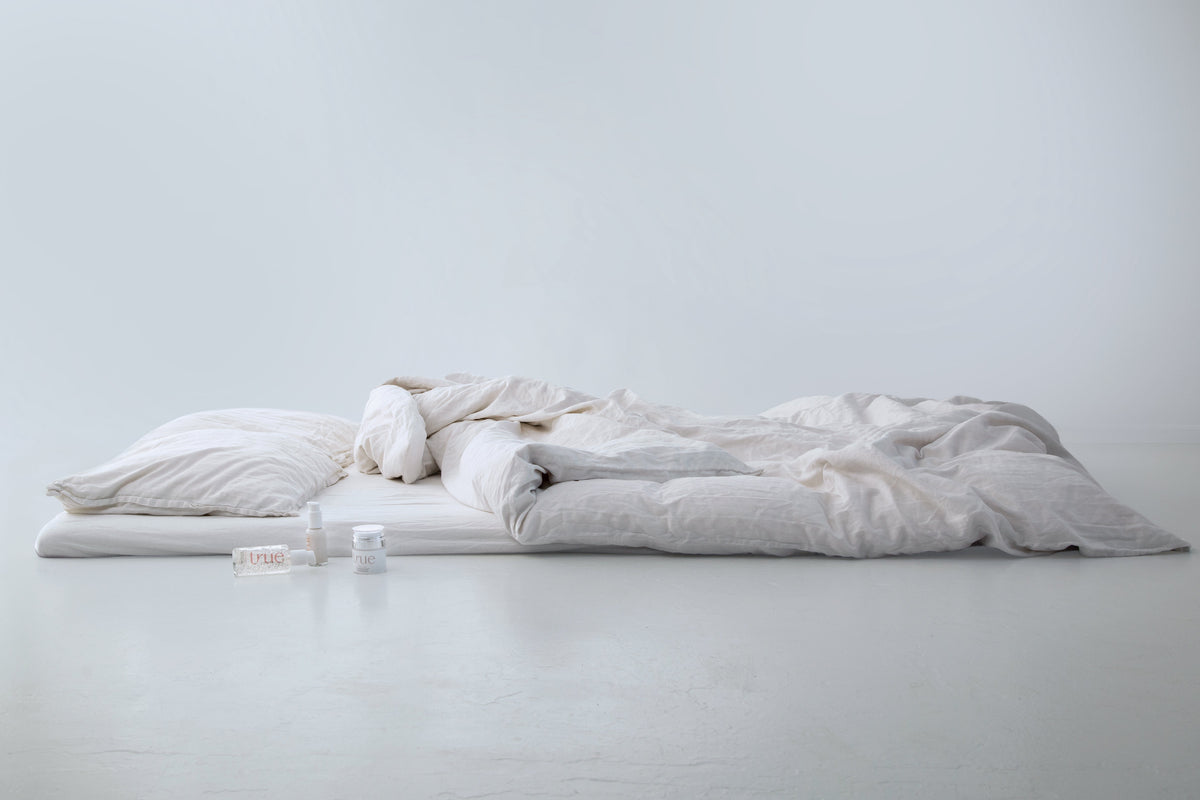
Morning vs. evening: what changes
In short
Same three products, used differently. Evening is for repair: cleanse, serum, cream. Morning is for protection: water, serum, cream, sunscreen.
Serum
Cream
Sunscreen
Serum
Cream
Skin has a clock
Measured around the clock, water loss through the skin is lowest in the morning and rises through the evening and night, when skin temperature is also higher. Sebum peaks around midday. Skin at night is warmer, more permeable and losing more water; skin in the morning is at its tightest and about to meet the day.
Evening: repair
Night is when the epidermis rebuilds, with cell division peaking after dark. Two things follow. This is the wash that matters, because the day's sunscreen, sebum and airborne particles should not stay on. And this is when humectants and a lipid-rich cream do the most, because they work against the highest water loss of the day.
Morning: protect
There is little to remove beyond the night's sebum, so lukewarm water is enough for most skin. Cleansing twice a day doubles surfactant contact without doubling the benefit, and surfactant contact is what dries skin. Keep the serum and cream, and add the step that matters most in daylight: in a four-and-a-half-year trial of 903 adults, daily sunscreen meant 24% less skin ageing. No evening step undoes a morning without it.
The routine
- 1 Morning: lukewarm water, serum on damp skin, cream, sunscreen.
- 2 Evening: cleanser for 30 seconds, serum on damp skin, cream.
- 3Oily skin can cleanse in the morning too. Most skin does not need to.
Figures are study averages; individual skin varies.
Sources (5)
- Yosipovitch G et al. Time-dependent variations of the skin barrier function in humans. Journal of Investigative Dermatology, 1998. Circadian measurement study, n = 16.
- Le Fur I et al. Analysis of circadian and ultradian rhythms of skin surface properties of face and forearm of healthy women. Journal of Investigative Dermatology, 2001. 48-hour measurement study, n = 8.
- Brown WR. A review and mathematical analysis of circadian rhythms in cell proliferation in mouse, rat, and human epidermis. Journal of Investigative Dermatology, 1991. Review.
- Vierkötter A et al. Airborne particle exposure and extrinsic skin aging. Journal of Investigative Dermatology, 2010. Cohort study, n = 400.
- Hughes MC et al. Sunscreen and prevention of skin aging: a randomized trial. Annals of Internal Medicine, 2013. Randomised trial, n = 903, 4.5 years.